

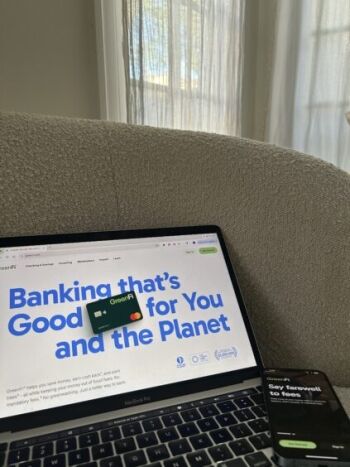
Why I Switched My Bank Account To GreenFi Checking And Savings

My introduction to personal finances was a trial by fire.
Anticipating my college graduation and the daunting prospect of “the real world,” I embarked on a journey to understand my money. Up until that point, I had been tracking every incoming and outgoing transaction on pen and paper. Literally everything — college work study checks, summer internship deposits, and all my visits to the local coffee shop. My banking app was auxiliary to my very analog process, but I knew it also held secrets like my credit score and my net worth. I decided to check it out.
Turns out, my credit score was easy to decipher. I logged into Experian and discovered a red chart, a 500s score, and the words VERY POOR on the screen. Turns out, a credit card had been opened in my name, and I was thousands of dollars in debt I didn’t know about. I went from thinking I had no credit to discovering I had bad credit. And faced with leaving the dorms and having to rent an apartment in New York City, I knew I had to do something about it, fast.
“I went from thinking I had no credit to discovering I had bad credit.”
The next few months — and years — were a mad dash to claw out of debt and a denigrated credit score. I will never forget the sigh of relief I breathed when I finally had good enough credit to be approved for a credit card of my own (Side bar: we need to normalize celebrating achievements like this! Looking back, I deserved a damn cake). Years later, I still have to remind my nervous system that I am no longer in a scarcity mindset and prevent myself from falling into extreme frugality or financial anxiety.
Recently, I realized: Now that I am no longer in financial survival mode, I can choose to be intentional about my money and how I manage it. I’ve moved away from my outdated pen-and-paper process, so why am I still banking with a legacy bank that doesn’t align with my process, my goals, or my values?
About GreenFi
Personal finance apps are in their gold rush era. Flashy new banks, which I always hear advertised on my podcast apps, offer features like crypto and betting, while others seem to offer nothing new at all. In a sea of sameness, GreenFi stands out for its value-driven approach.
Described as a “climate-focused financial technology company,” GreenFi goes beyond the buzzwords to make personal finance simple. Like the legacy banking apps I was familiar with, they offer checking, savings, and investment options within the app. However, unlike those apps, GreenFi prioritizes clarity on how your money is working to support — rather than compromise — climate action1.
“Described as a ‘climate-focused financial technology company,’ GreenFi goes beyond the buzzwords to make personal finance simple.”
Because here’s the thing: I was starting to feel icky about using my legacy bank. Big banks were the targets of protests I supported, they were making statements I disagreed with, and they were actively profiting from harmful legislation. Yet, I was putting my money into them day after day. Even watching my investment portfolio grow started making me feel complicit. Yes, I was making money, but so were institutions that I didn’t support.
The knowledge I had acquired during my financial journey had taught me the basics of investing, the importance of high APY savings accounts, and how to manage my finances digitally. However, it had never considered the moral and climate impact of where I put my money. I knew I couldn’t just take my money out of my bank accounts and keep it in a shoebox under the mattress (though I was tempted). GreenFi made it simple to switch my providers and make my money work harder for the environment without compromising my money management system.
How to switch to GreenFi
No stranger to banking interfaces by now, I thought I knew what to expect from GreenFi. But instead of the clunky-but-standard bank interfaces I was used to, GreenFi immediately felt sleek and intuitive. The user-friendly app is built for those who value a stylish and substantive experience. I was able to navigate the app within minutes of making an account and didn’t feel turned off or overwhelmed by the design.
“The user-friendly app is built for those who value a stylish and substantive experience.”
Downloading the app was simple. Switching over felt daunting. Most of us open a bank account as teenagers and stick with it. So I’ll admit, it took me a few days to face the task. But my monthly payment (yet another sticking point — why was I paying for the privilege of banking with a company I didn’t support?) was approaching, so I had to make the switch.
First things first: GreenFi doesn’t have a mandatory monthly payment. You can sign up on a sliding scale to support its mission (with $5 as the average), or pay $0 a month. Green flag. GreenFi also doesn’t punish you for not keeping a monthly balance. While other banks charge you a fee for not having anything in your account, GreenFi doesn’t.
And the money you do put in your account? As part of their core philosophy, GreenFi doesn’t use deposits to fund fossil fuel exploration or production. All you have to do is sign up, fund your account from your existing bank, and set up direct deposit. As an added bonus, your direct deposit will often hit up to two days early2 — imagine my surprise when I got my paycheck the day before I was expecting it (yes, I did treat myself).
More GreenFi green flags
Your checking account comes with a debit card3 that ships in the mail. Made of from 100% recycled plastic material, this card is the physical manifestation of GreenFi’s climate mission. And with every swipe, you can vote for a better world when you support climate-friendly brands. GreenFi helps you identify brands that align with its vision by earning cash-back4 on participating, vetted brands. You can even round up every purchase to the nearest dollar to plant a tree with the difference!
“Made of from 100% recycled plastic material, this card is the physical manifestation of GreenFi’s climate mission.”

Another tidbit I learned in my financial journey: Always separate your savings. For a long time, I had one big checking account, and everything went through there, from bills to unsuccessful savings goals. Using separate savings accounts — and even opening different ones for different goals, like travel and my emergency fund — helped me keep track of my numbers. However, in most banks, those accounts just sit there earning little to no interest.
With GreenFi, your savings accounts earn you money while they sit there with a rate of up to to 3.25%5, on par with HYSAs, which often exist in a separate ecosystem than your checking account. That means your money is making money, not just costing you money.
Beyond saving, I had also started dipping my toe in investing. However, most of the investment options I opposed funded companies, even funds that claimed to be all about sustainability. With so much greenwashing in the industry, it was refreshing to discover the GreenFi Redwood Mutual Fund. Instead of having to pick individual stocks or park my money in exploitative funds, GreenFi’s Redwood Mutual Fund offers an investment option that guarantees you’re not investing in fossil fuels and high-carbon assets. The fund includes companies with lower emissions, with its carbon footprint per dollar invested being approximately 56% lower than that of other popular funds.
The missing pieces
While GreenFi’s products are clear and value-driven, they aren’t as robust as other financial options. In my research, I discovered comparable apps with more robust reward offerings and integrations with services like Zelle and credit cards to maximize reward opportunities. While payment and lending products are in development, they are untested and won’t come with the experience of other providers.
“While payment and lending products are in development, they are untested and won’t come with the experience of other providers.”
Some of GreenFi’s features are also hidden behind a paywall. While you can access most of its products for $0 in the Pay What is Fair scheme, there is a membership option that costs $7.99/month or up to $5.99/month (with annual billing), offering perks such as higher APY and cashback, which is only available to paying members.
My final thoughts
Despite fewer features than other options, especially at the non-paid tiers, I find it exciting that as a climate-conscious consumer, I can put my money where my mouth is — literally.
“I find it exciting that as a climate-conscious consumer, I can put my money where my mouth is — literally.“
GreenFi offers consumers clarity in a landscape dominated by big banks that can get away with greenwashing and obscuring their values. By contrast, GreenFi is on a mission to keep improving its product and letting consumers finally take charge of the climate impact of their purchases.
Every time I open GreenFi, I am reminded that I have a choice in the little things I do, from where I shop to how I do it.
THIS STORY IS IN PARTNERSHIP WITH OUR FRIENDS AT GREENFI
Langa Chinyoka is a Contributing Editor at The Good Trade. She is a writer and strategist based in Los Angeles.
- Planet Protection offsets the estimated CO2 emissions from driving your vehicle based on purchases at gas stations. Verified carbon offsets are purchased quarterly, in aggregate, to account for estimated emissions from all Planet Protection subscribers. This feature is bundled into the GreenFi Plus program and is not offered as a standalone feature that can be purchased separately. ↩︎
- GreenFi’s early direct deposit of funds service is not guaranteed, is subject to payor’s support and the timing of payor’s payment instruction, and is based on a comparison of our policy of making funds available upon our receipt of payment instruction with the typical banking practice of posting funds at settlement. GreenFi generally makes these funds available on the day the payment file is received, which may be up to 2 days earlier than the scheduled payment date. ↩︎
- The GreenFi Mastercard® Debit Card is issued by Coastal Community Bank, Member FDIC, pursuant to licensing by Mastercard® International Incorporated. GreenFi is under separate ownership from any other named entity. GreenFi is not a bank.
↩︎ - GreenFi’s Cash Back program is subject to change at any time and without notice, including reversal of rewards for abuse, fraud, and other illicit activity. Cash Back rewards are generally credited on the first day of each calendar month. For additional Cash Back details, click cashback on purchases & Green Marketplace.
Annual Percentage Yield (“APY”)” is accurate as of 04/30/26 and is subject to change. ↩︎


