

How I Discovered A Cause I’m Connected To — Halfway Across The World

Going on safari is one of those bucket list items that I had put so far in the future, I had hardly even given it much thought. But I woke up one morning to my boyfriend tapping my shoulder. “Do you want to go to Africa in June? I need to know by the end of the day!”
He’d been invited on a trip with friends, to a place called Sarara, in Kenya. Without thinking, I blurted out, “Of course!” Because who says no to an invitation to Kenya?
“Who says no to an invitation to Kenya?”
As the days went on, I imagined myself in khaki pants with binoculars looking at elephants and giraffes… but the adventure felt so far away from everyday life, it was hard to wrap my head around what was even in store for us.
When most people think of safari, they imagine roughly what I did: Glamping, a line of Land Cruisers idling on flatlands, an industry built on the chase to view the “big five” — lions, leopards, rhinos, elephants, and buffalo. And that version can come with some baggage. Tourism often has little regard for the Indigenous peoples, and the profits go into the pockets of foreign operators instead of supporting the land, animals, and people that call it home.
But the moment we landed at Sarara, and a friendly group of Samburu guides greeted us at the airstrip, I knew I was in for something else entirely. What I didn’t realize yet was that I had just landed in the middle of one of the most successful community-led conservation projects in the world.
“I had just landed in the middle of one of the most successful community-led conservation projects in the world.”
The word “safari” could hardly do it justice. Sarara is a community conservation project run in partnership with the Indigenous Samburu people. It’s set on 850,000 acres of wilderness in the Mathews Mountain Range in northern Kenya.
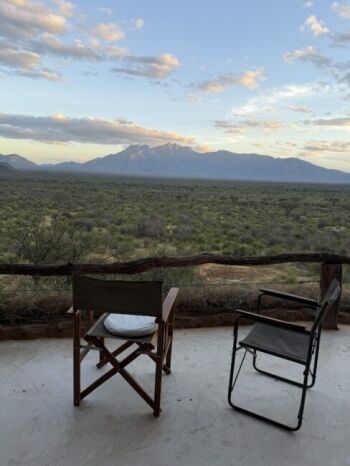
Today it’s all open, green, sprawling land, home to elephants, giraffes, and animals that are respected and protected. Of course, Sarara welcomes visitors, but it’s done mindfully, centering the native people, animals, and land.
After visiting, I can say without a doubt it’s one of the most beautiful and magical places in the world.

But just a few decades ago, it didn’t look like this. According to Sarara, elephant numbers were falling as international demand for ivory grew, and poaching was a huge threat across the country. Animal populations plummeted, including a herd of 15,000 free-roaming elephants that dropped to around 400. And in turn, the ecosystem suffered, changing the texture of the landscape and making it less productive for the Samburu and their livestock.
Then in 1995, the Samburu community established the Namunyak Community Conservancy. And two years later, they partnered with a couple, Piers and Hilary Bastard, third-generation Kenyans dedicated to wildlife conservation, and opened Sarara Camp — a locally-owned tourism model. Because the conservancy is community-owned and community-governed, the money stays locally, the animals are protected, and the Samburu remain in charge of their own land. (And three decades later, that herd of 400 elephants is now over 6,000. Pretty amazing.)
“Because the conservancy is community-owned and community-governed, the money stays locally, the animals are protected, and the Samburu remain in charge of their own land.”
While I was there, I got to spend time with Jeremy and Katie, who took over Sarara in 2010 from Jeremy’s father, Piers. They’ve dedicated their lives to it, living on the land year-round with their kids, and in 2016 they co-founded Reteti Elephant Sanctuary, which rescues and releases orphaned elephant calves and is run by the Samburu community. Can you imagine having elephants, zebras, and giraffes in your backyard? That’s the norm for Jeremy and Katie’s family.
Then there’s the Milk to Market program. After an orphaned baby elephant was nursed back to health with the aid of goat’s milk, it inspired a business venture for the Samburu women. Now over 1200 “Milk Mamas” sell locally sourced goat milk to Reteti Elephant Sanctuary, where it feeds the orphaned calves. For many of the women, it’s the first income they’ve ever earned.
See how all these pieces work together — equal care for animals, ecosystem, and the people? And the “community-led” part of conservation ended up being one of the most inspiring takeaways from the whole trip. Honestly, I’ve told more people about the Samburu than I have about the animals.
The Samburu have been pastoral nomads for thousands of years, herding livestock and moving with the seasons. They’re so connected to the land that they can identify seemingly every plant and its edible, medicinal, or utilitarian use. One day our guide pulled over, excited to show us a plant that turned into eye drops when you squeezed it, then one that worked like sandpaper, then one that made a delicious tea. They’re true stewards of this place. And what got me most was that they were just as moved by the animals as we were, even though they see them every day.
What makes it a successful strategy is ownership and sustainability. When everyone leaves, including donors and conservation organisations, the community should still have the capacity, commitment, and ownership to continue conservation.” – Dorcas Lolngojine, Head of the Milk to Market Program
Beyond the remarkable success of Sarara, and the beauty I encountered while I was there, there was a stat I overheard at dinner that really inspired this piece. Animals and the environment receive only about 4% of total US charitable giving (Giving USA). And of the money that does reach animal organizations, most of it goes to household pets, cats, and dogs. So despite everyone’s well-intentioned care in the direction of wildlife, our charitable efforts don’t seem to be matching up.
We love the photos, the social media posts, the little wild animal trinkets. But they live so far from our day-to-day that most of us have never really considered what supporting them looks like. Which got me thinking: What do I care about and do my intentions match where my money actually goes? And being that close to the wildlife cemented it for me – I really do care about wild animals and conservation.
Looking back at my childhood, I grew up on 36 acres of nature, surrounded by farm animals. From hearing wild bird songs to corralling animals in the barn to hearing the meow of a baby cat in the garage. Animals have had such a near and dear place in my heart. And in my adult life, living in the pavement of LA, I lost touch with it. Being in such expansive nature reminded me of my roots…even if the animals looked a lot different!
I came home reminded of the importance of thinking about things outside of ourselves. It’s easy to get caught up in the drama of life and work — but it’s time to take a moment to choose causes I care about to contribute to. And you don’t have to travel to Kenya to do that. Sarara is just an organization that I visited and can vouch for, so it’s where I’m starting.
“What do I care about? And do my intentions match where my money actually goes?”
I’ve adopted an elephant named Kimani, who was rescued from a well when he was only three days old and is now thriving in the care of Reteti. While I was there, I got to watch a feeding. The keepers sing, and the elephants come bounding through the gates, unmistakably joyful.
My trip to Sarara really opened my eyes and expanded my worldview. And community-led conservation was a big reminder that change doesn’t happen in isolation. It requires us to participate.
Thinking about something bigger than yourself feels really good — selfishly, even. And you don’t have to travel halfway across the world to get involved. Start looking for organizations where you live that are doing work you actually care about. Wildlife, homelessness, education, climate — whatever resonates with you. Organizations like the Audubon Society are stateside opportunities to support animals in your backyard! Research, visit the organizations, talk to the leadership teams, go to an event, understand why they’re looking to fundraise and where it ultimately goes. Become an advocate because you’ve been in it, not just read about it. You could even rally a group of friends to volunteer one weekend a quarter or throw a fundraiser. Make it fun. Community-led change happens everywhere, not just in Kenya. It happens in your backyard when you decide to participate instead of just observing.
“Change doesn’t happen in isolation. It requires us to participate.”
I’ll leave you with a quote from Jeremy:
“Conservation programs cannot operate in isolation. Everything is interlinked. People need nature and vice versa. Healthy and thriving communities create the runways for land and wildlife conservation, and often healthy land results in healthy communities. Without clean air and water, and without healthy soils, we have nothing.”
Grace Abbott is a LA-based freelance Brand & Marketing Strategist and a Contributing Editor at The Good Trade. She has a degree in Graphic Design from Parsons School of Design and is the founder of How To Go Freelance — a brand dedicated to empowering creatives to monetize their skills and build personal brands. Beyond work, she’s always studying a new spiritual modality, painting her bedroom a new color, practicing Pilates, hosting friends, or going on a nature walk with her chihuahua, Donnie. Find her on Substack or Instagram.


