

How Revisiting Home Movies Transformed My Sense Of Self

A few days before my 35th birthday, I received a birthday card. The same type that I do each year, with my mother’s handwriting reliably written across the envelope.
“It’s funny how remembering requires constant attention.”
Usually a gift comes independently by email or FedEx — a gift card, some item of clothing I’d been wanting — but the card is always a separate sentiment. It’s somehow important. So important that I still get cards for Easter and for Valentine’s Day, both holidays that I feel I’ve grown out of. Ones that feel expired since I haven’t celebrated alongside my family in many years. They’re mementos, I guess, of my childhood, in that way. It’s funny how remembering requires constant attention.
This year, when I opened my birthday card, a USB drive plopped down onto the counter, escaping the fold. I knew what it was immediately.
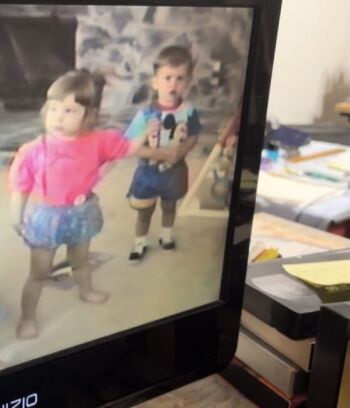
My sister had relayed to me that my stepfather was in the process of digitizing our prized stack of VHS home movies. It felt like impeccable timing. I was old this year in a new way. It wasn’t just one thing. My nasolabial folds were deepening, I was entering geriatric pregnancy age (no matter if that actually means anything healthwise), and I was divorced. I wasn’t 7 anymore. Yet there I was, 7, on the digitized tapes, singing an endless song for my mother.
What I saw in the home video
I was using a big piggy bank shaped like a red crayon as my mic stand. (It was the 90s.) Somewhere between a clown, a pop star, and a standup comic, my utterances took on melody at times, while at others, there were funny little voices, and certainly ploys for attention. As if I wasn’t getting enough while my baby sister quietly sits in the background.
I brought this scene to my psychoanalyst. I was horrified by the demand on me to perform for the camera, about how oblivious I was to my sister, and mostly about how I went on and on and on. My analyst asked, in so many words, so what? What if we do go on and on and on? She was pointing to my inhibition. It was a moment to rework whatever impression I had in my mind. Could it be possible for me to see this scene differently?
We tend to live with the sense that the past is final. You can’t undo an action, or un-say something. What is done is done, as they say. But is that the last word when it comes to our memories?
“We tend to live with the sense that the past is final. But is that the final word when it comes to our memories?”
What is memory, exactly?
In our era of brain science, it is agreed upon that memory is a constructive process. It isn’t a direct reproduction, in some other format, let’s say. Instead, depending on who you ask, it is an adaptive function of our minds. Or it’s a kind of writing.
“Memory is a constructive process.”
One way to think about memories is to consider how they are additive. Something happens once when you’re a child. Let’s say you’re singing with a big red crayon full of pennies. You also grow up with the refrain that red is your mother’s favorite color. Coloring inside the lines always required of you a certain precision that felt frustrating. Now, when you see a painting a Rothko painting with the canvas all wiped in red, what do you think? It’s the registration of the color red, through all of these memories, that is evoked. Layer on top of that cultural meanings, the natural occurrence of red, and whatever else there may be.
For one, this shows how our memories are shaped over time by new input that includes generically similar material. It also shows just how dense our associations are for the most basic sensory input. Memory, when it is conscious, simplifies things for us, creating an easy correspondence. But there are other threads too, ones that we blot out, because to feel that every time we see red is…well, a lot.
How I’m working with my home videos
So, what about home movies? The movie might be the paradigmatic image of a memory, actually. We can’t help but imagine our brain as a projectionist, playing a memory on the back of our eyelids when it is recalled.
But while we tend to think our photos and videos preserve memory, they might be better thought of as stripping back memory from experience to allow for something new. Over time, certain scenes take on meanings that are connected to how we see ourselves. The home movie takes you back to the source to explore what other direction it might have gone. What other direction it might go.
“While we tend to think our photos and videos preserve memory, they might be better thought of as stripping back memory from experience to allow for something new.”
We’re always writing and rewriting, each new sensory impression corresponding to a previous trace. It’s the early memories that keep us locked in place, that psychoanalysis tries to address by privileging childhood as a formative site for one’s psychology. The home video brings us back to that place and asks us to look at it — Was it really so bad? Was it worth all the shame and the suffering? Or were you just a child, singing for your supper, or pretending to?
Ashley D’Arcy is the Senior Editor at The Good Trade. She holds an MA in Philosophy from The New School for Social Research and has contributed to esteemed outlets such as The Nation, 032c, and Yale School of Management’s Insights where she’s leveraged her expertise in making complex ideas accessible to a broad audience. In addition to her editorial work, she is training as a psychoanalytic mental health professional and provides care to patients in New York City. Ashley also explores sustainable fashion, clean beauty, and wellness trends, combining thoughtful cultural critiques with a commitment to mindful living.


