

How Listening To Audio Erotica Helped My Partner And Me Communicate Better In The Bedroom

Sex has always been important to me, though not always for the right reasons.
When I was younger, I struggled with an insecure attachment style. I let my self-worth be determined by external validation — namely, how desirable I felt to men.
Attention from men was my complete preoccupation from the time I entered high school and well into the following decade. Feeling the heated gaze of a gorgeous stranger, getting approached in public, followed by the free drinks and all-night dances, and finally exchanging numbers in the wee hours the following morning weren’t the decorative trivia of an otherwise richly lived life, but the very foundation of my self-esteem.
“Sex has always been important to me, though not always for the right reasons.”
If that sounds like a flimsy foundation to you, then you are correct.
Defining myself by whether I felt desired meant that I was almost never just “being myself,” because I had no idea who that was. I was a fiction, a versatile and responsive creature who was quite skilled at giving the people what they wanted from me. It made me lonely, desperate for the only thing I was never going to get by living my life as a performative try hard — a true, honest connection with another human.
Instead, I jumped from one fraught relationship to another, choosing the sort of dynamics that I thought I deserved. I stayed for far too long with men who kept me at a distance, who were, for some reason or another, unavailable. They weren’t bad people, but whatever drew them to the person I was at the time was not good, either. I convinced myself I was falling hard and fast every time, while still maintaining a string of flirtatious, banter-filled text and message exchanges with other men on the side, “just in case.” When you’re convinced that your boyfriend could break up with you in literally every conversation, you do things like this. Or at least, I did.
Sex was the only way I would feel close to these partners. It was how I reassured myself that they weren’t secretly about to leave me — not even I could imagine being dumped by someone while he was literally inside of me.
So sex was my top priority. It was the measure of our relationship, how I knew I was being a “good girlfriend,” and the only way I could quell that little voice in my head that was always pointing out signs that my desirability had faded, that my partner didn’t want me anymore.
“Sex was my top priority. It was the measure of our relationship, how I knew I was being a ‘good girlfriend.'”
I had a lot of sex. Quantity was the name of the game — both frequency and duration — and by these calculations, I was a very good girlfriend. Even if I felt like crap most of the time, at least my sex life was good, right?
It probably goes without saying, but reader: My sex life was not good.
With a handful of exceptions, my sex life didn’t really get good until I was in my thirties. And it didn’t get great until I was over 40 and ten years into my marriage.
What changed? Exactly what you’d expect: I finally stopped chasing the dragon of unavailable men, and I stopped centering my value on whether or not I got hit on at the grocery store.
I started investing instead in my other interests — in learning how to cook and getting more serious about my yoga practice. I started publishing poetry. I started working for an adult literacy nonprofit and spending time in communities that were bigger than I was. I spent more time sharing experiences with friends that felt more like mutual bonding and less like transactions. I stayed single for months. Sex was still important to me, but I was only having it with myself. (And it was really, really good.)
“I stayed single for months. Sex was still important to me, but I was only having it with myself. (And it was really, really good.)”
I was twenty five, and those few months changed my life. I discovered who I was for the first time, without using any of the external measures I’d been relying on before. I spent so much time on my own but I was never lonely. I had so much to do and to think about, so many people to spend time with and learn from. My friendships grew and deepened, and I learned to have trust in these relationships, and what it felt like to be close to someone without pretending, or relying on sex to simulate closeness.
It was a rich, and beautiful time in my life, particularly for my friendships. One friend and I started cooking together every week, and then we started going out to restaurants to taste dishes we’d been learning to make. In early October, we went out for oysters, and then we went for a long walk. It was chillier than we’d expected — we could see our breath in the night air. I said I was cold and my friend put his arm around me, the cuff of his sleeve catching my shirt and making it ride up a little at my waist. When he tugged it down, I felt his warm fingers graze my skin and I shivered. Later, in my kitchen, my friend looked at me in a way I’ll never forget — it was both a question and its answer — and then he kissed me.
“My friend looked at me in a way I’ll never forget — it was both a question and its answer — and then he kissed me. “
It sounds like a punchline to reveal that the friend is now my husband, but I’m telling it this way for a reason. It was the beginning of the most important relationship in my life, and it was also the only romantic partnership that started with a remotely healthy foundation — one of friendship, trust, and honest connection.
All of these things are at the heart of a good marriage, and are ideal for great sex. And we do have great sex — now. (For the record, I am over 40, we have been married for more than a decade, we have a young child, and we are having the sort of sex I thought was only allowed for twenty-year-old models with enough expendable income to take a last minute trip to Fiji.)
But in the beginning, it was …okay. There were empirical improvements, without a doubt, but when the bar is that low it’s not exactly a challenge to clear.
For starters, he cared about making me come. And that was new.
“I rarely orgasmed with my previous partners. Now I was dating a man whose pleasure hinged on my pleasure.”
When I used to use sex to soothe my insecurities, I centered the experience around his pleasure. When I thought the success of the act hinged on ejaculation, it might not be a surprise to learn that I rarely orgasmed with my previous partners. Now I was dating a man whose pleasure hinged on my pleasure — which is how I learned about the “She comes first” rule of heteronormative sex.
So for sure, there were improvements. But I’d just spent all this time learning about myself and my desires, so I was aware that I had a few that weren’t quite being met yet. I didn’t yet have the confidence to figure out how to voice them — and I had no idea where I was going to find it.
This might all seem like an overly long build up to get to audio erotica, but telling this story is the perfect illustration for why audio erotica is so effective.
Let’s start with the basics: Erotica is art meant to arouse sexual desire. It can be any art form — literature, photography, dance, film — that explores sexual desire, especially the emotional and relational aspects. While porn is more about the explicit visual of a physical sex act, erotica might not feature a sex act at all (though it often does!). Narrative is essential in erotica, where any encounter is contextualized and heightened by the built up expression of passion and desire.
“Narrative is essential in erotica, where any encounter is contextualized and heightened by the built up expression of passion and desire.”
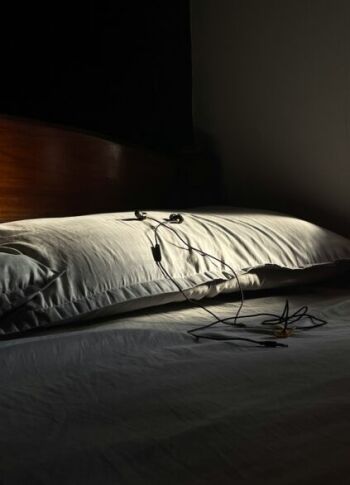
Audio erotica is a diverse range of audio media designed to arouse. It can be anything from erotic stories to guided masturbation meditations to ASMR to overheard sexual encounters. It varies in production quality, from full-range scripted audiobook styles to a direct-to-listener improvised “ramble” recorded on an iPhone. But the content is all designed to be dynamic, engaging, and hot.
I first stumbled into the audio erotica world via a steamy scene in an audiobook romance. A friend had recommended the “Outlander” series — the first of which is a 40-hour audio that I was listening to in half hour increments while walking the dog. This was well before the show came out, and having never really read historical romance before, let’s just say I was not prepared for the moment when Jaime took Claire to the marital bed. What had been a vaguely interesting story suddenly had me by the throat, and I started taking the dog on longer and longer walks.
It wasn’t just that the sex scenes themselves were hot, it was how the story made me so much more invested. Romance novels take readers on the journey of falling in love, simulating all the swooping sensation of the early stages of a new relationship. When you’re along for that sort of ride, sex scenes alchemize from porn to erotica. The narrative triggers full-bodied sensations of sexual desire, with all the complications and multifaceted emotional stakes that give it depth and richness.
“It wasn’t just that the sex scenes themselves were hot, it was how the story made me so much more invested.”
After that, I started listening to more and more romance novels. I loved being on the heroine’s journey, and getting to fall in love alongside her. Historically, this is a genre that centers female pleasure, in opposition to conventional media that caters to a male gaze. So the sex scenes weren’t just arousing, they were satisfying. I loved reading as these characters learned what they wanted and how to ask for it, and I loved the enthusiastic partners who were so eager to give it to them. I loved getting to see how they confronted their own self-doubts or limiting beliefs. In the moment when they overcame their final hurdle, I shared in their victory as if it were my own, because I’d been right there with them the whole time.
Over the years, I started to notice that these stories were having a much bigger effect on my life than if they were merely entertaining. My worldview on sex and pleasure had expanded, as each book exposed me to everything from different ways to initiate sex or how to phrase something I wanted to try. I even read examples of how to say no to sex in a way that wouldn’t hurt my partner’s feelings — and saw how a loving and respectful partner could be expected to reply.
“Each book exposed me to everything from different ways to initiate sex or how to phrase something I wanted to try.”
And because romance writing is made up of a lot of interiority, I had a new sort of confidence about what my introverted husband might be thinking during sex. Instead of panicking that the quiet meant he was bored or thinking something critical about my body, my mind was now supplying me with a plethora of affirming material to fill in those blanks. (For the record, whenever I asked my husband if he was bored, he looked at me like I was an alien. “We’re having sex. No, I’m not bored!”)
The women in my books were relatable, their lives and interests and desires felt familiar to me. Getting to join them in their intimate moments wasn’t just fun and horny — though it was that too! — it was informative and inspiring. It helped me to see my own desires more clearly and then empowered me to act on them by showing me how it’s done.
I saw myself in these heroines. If they could start out as self-conscious, people-pleasers who had never masturbated and end up confidently sitting on their man’s face by the end of the book, then what incredible transformation lay in store for me?
I was galvanized. I was aroused. I was going to level up my sex life by getting my husband to talk dirty to me.
Listen, you don’t know what you don’t know. And what I didn’t know was that the handful of pages of sex scenes in these romance novels hadn’t given me quite enough information for what I wanted to do. And while they had empowered me to ask for what I wanted, it still wasn’t quite a match for a lifetime of conditioning to make myself convenient and easier for others.
So broaching the topic wasn’t exactly the tour-de-force I’d envisioned. Instead, it went a little more like this:
Me [trying not to sound nervous, so instead coming across overly casual]: Hey, I was thinking we can try something new in the bedroom, sometime.
Him [instantly alert, giving me his full attention]: Yeah? What did you have in mind?
Me [starting to lose my nerve, trying to hold on to it…]: Well… I was thinking about maybe, like, um. Maybe we could try, you know…
Him [deeply intrigued]: Yeah…?
Me [all in a rush]: Like, a-little-dirty-talk?
Him [unreadable]: Oh?
Me [fighting the urge to backpedal, starting to sweat]: Just a little — a little bit?
Him [neutral, but notably not enthusiastic]: Um, okay, sure. What do you want me to say?
Reader, absolutely nothing came to my mind. No phrases, no words — the part of my brain where language was stored had been wiped clean. If a tumbleweed drifted by, I wouldn’t have known what to call it. All I could hear was the ringing in my ears that meant Abort! Abort!
“All I could hear was the ringing in my ears that meant Abort! Abort!“
Me [far too chipper, almost bird-like]: Um, actually, nevermind! It was just an idea.
Him [recognizing panic, trying to show enthusiasm, but also confused]: No, no — we can definitely try it! I just don’t know what you want me to say.
Me [already walking out of the room]: Totally. Um… let me think about it okay?
I won’t lie — I was lightly crushed. But looking back, I can see clearly how it went so wrong.
First: I had been on this whole transformative romance reading book journey, and my husband had not. And as open-minded and supportive and curious as he is, it would just take a lot of time to give him the dozens of books he’d need to read to get on my level.
Second: My timing left a lot to be desired. Instead of bringing this up in a more inspiring setting — say, while we were actually in bed — I think I cold called him in the middle of breakfast. Who knows how differently this could have gone if I’d gasped it out in the heat of passion, candlelight flickering over our skin?
Still, the desire was out there now, and the seed had been planted. The rest was going to come down to logistics.
Which is where, finally, audio erotica comes in.
Every now and then, the algorithms that govern our targeted marketing landscape really knock it out of the park. I’d been getting ads for an app called Quinn for months. One day, I saw that Kate Moennig, the actor who plays Shane on the “L Word” (iykyk), did an audio series for them and I found myself in the app store so fast I barely remember paying. Within minutes, I was listening. Within seconds, I was hooked.
Quinn features voice actors creating audio erotica that is searchable by tags and creator. There are thousands of audios to peruse, with an extremely expansive list of tags for every possible interest, fantasy, or desire you can imagine. Their voice actors and content creators are people who generally already had an established internet presence — or, like Moennig, are actual celebrities. They also do collaborations with or inspired by popular movies and TV shows (they recently just had Connor Storrie and Hudson Williams from Heated Rivalry do a series!). There are also sleep aids and guided meditations — both come in sexy and SFW varieties.
“There are thousands of audios to peruse, with an extremely expansive list of tags for every possible interest, fantasy, or desire you can imagine.”
And the creators are prolific, often posting on a weekly basis — some keep a regular cadence, so you know a drop is coming on each Tuesday, for example. The length of time is everything from 5-75 minutes long. And while there are a few multi-voice audios available (tagged as “collabs”), by and large the audios are a single voice speaking directly to the listener — either in a meta scenario or in a role-play.
The strong culture of consent is just one marker that it’s clearly women-made, but what stands out to me about Quinn compared to other similar apps is that it’s truly a place for a more expansive and diverse audience. There are creators and tags for all genders and orientations, but notably for me, Quinn has content targeting straight men too.
So back to my problem: I wanted my husband to talk dirty to me, but I didn’t know exactly what I wanted him to say, and I couldn’t really figure out how to get him to do what I was imagining. He didn’t really want a script, and he was generally open to the idea, but needed some sort of guidance to get started.
“I wanted my husband to talk dirty to me, but I didn’t know exactly what I wanted him to say.”
Enter audio erotica.
Audio erotica is, essentially, all dirty talk. And within a week of downloading the app, I had listened to a lot of it.
I listened to everything: Male creators for females (M4F), female creators for females (F4F), and then F4M, and lots of M4A (anyone). I listened to various power dynamics (Msub or Mdom, and the delightful “switchy”), and some familiar tropes like Friends to Lovers, and less familiar tropes like Stranger to Lovers. I googled a lot of tags to learn what they meant, and discovered the cozy glory of audios featuring “pleasure doms” who were all about aftercare. I also listened to whole catalogues by creators I liked, regardless of the tags, and I learned so much from this — specifically when I was aroused by scenarios or role-plays I never would’ve chosen on my own.
In my “studies,” I realized that when I said I wanted my partner to talk dirty to me, what I was asking for wasn’t anything particularly creative or filthy. Looking through the audios I found myself saving in my “favorites” folder made it really clear that what I was actually asking for was much simpler than that.
Almost all of my favorite audios have male partners telling the listener how much they want her, and how good she feels when they’re having sex. Then, for most of the audio, they are essentially narrating what’s happening, but they sound deeply affected by it. Think: “I like this. I want to be here,” only with more cursing and panting. And it’s very, very hot.
Someone like my partner might make the excellent point here that actions speak louder than words — and when we are actually having sex, isn’t it implied that my partner is enjoying it and wants to be there? Yes, sure. But actually whispering, “You feel so good.” Or gasping out my name? Trust me, it just hits different.
“Really great sex isn’t about logic and reason. Really great sex is about being in our bodies — our animal bodies.”
And here’s the thing: Really great sex isn’t about logic and reason. Really great sex is about being in our bodies — our animal bodies. The parts of ourselves that won’t feel ridiculous saying out loud “I want to be inside you” when they are in fact already inside you because we’re having a shared experience that’s so deep in our bodies that the words are more of an exaltation than new information. They’re vibes.
And vibes are best understood when they’re experienced, not explained.
I sent my favorite audio to my husband. And what I didn’t have the words to describe not only became clear to him, but also accessible. Because an audio is a representation and also an invitation; he could listen to the scenario that turned me on, and then imagine turning me on that way himself.
If you’ve ever been in a book club, you know how sometimes the discussion can reveal new connections and ideas that you would never have considered on your own? Maybe you make a new friend, or forge a deeper bond with someone you know through this shared experience.
This is basically what happened after my husband and I started sharing audio erotica with each other.
At first, we let the content do the communicating for us. We shared how it made us feel, but we didn’t yet use a lot of the more specific words from the erotica lexicon. But the more we listened, the easier it became to start trying things in bed, and saying more out loud.
“At first, we let the content do the communicating for us.”
It happened quite naturally, without much planning. Slowly, as we continued sharing content and got better at debriefing, our ability to speak more comfortably about sex expanded. We learned lots of ways to check in with each other before, during, and after, and gained a new confidence in asking for what we wanted, and trying something totally new.
One day, after a notably good afternoon in bed together, he looked at me and said, “I feel so close to you.”
In that moment, I realized that it was never about the dirty talk at all. Because even if, all the way back then, he’d instantly told me to get on my knees and called me a good girl, it wouldn’t have been what I was truly looking for. This was what I wanted, here — lying in my partner’s arms, flushed, sweaty, and transcendentally happy to be experiencing this moment in life together.
I wanted a deeper connection to the person I love, and the joy of hearing him affirm in words that he was feeling it too.
“I wanted a deeper connection to the person I love, and the joy of hearing him affirm in words that he was feeling it too.”
Ultimately, audio erotica gives us a safe way to explore our curiosities and desires, and to share these with each other. Unlike porn, there are no questionable ethical dilemmas to grapple with that kill the vibe, and the more thoughtful expressions of emotion feel comprehensive and relatable.
There is a strong culture of care and consent in the audio erotica world too, which is a powerful backdrop for the content tagged as “rough” — it makes it so clear how much trust there is in healthy sexual relationships, the kind that makes it possible to safely pursuit ideas that we might have been conditioned to think are “dirty” or “bad.”
In the end, it isn’t really just about these desires on their surface, but how they are different avenues that help us to connect with each other during sex. And these connections are the what transform sex into intimacy. Audio erotica helped us find the communication strategies that strengthen these connections — sometimes with words, sometimes even dirty ones.
But it also helped me to trust the silence more, because the vibes are good. Sometimes, in our animal bodies, we can’t remember how to talk, anyway.
Stephanie H. Fallon is a Contributing Editor at The Good Trade. She is a writer originally from Houston, Texas and holds an MFA from the Jackson Center of Creative Writing at Hollins University. She lives with her family in the Blue Ridge Mountains of Virginia, and she is the author of Finishing Lines, where she writes about her fear of finishing, living a creative life, and (medical) motherhood. Since 2022, she has been reviewing sustainable home and lifestyle brands, fact-checking sustainability claims, and bringing her sharp editorial skills to every product review. Say hi on Instagram or on her website.


