We Spoke With Lindsay Dahl On Clean Living, Labels, And Laws

👩💻 Join us on March 11 for a live discussion with Lindsay Dahl! If you’re not already part of our Substack community, sign up here for your spot.
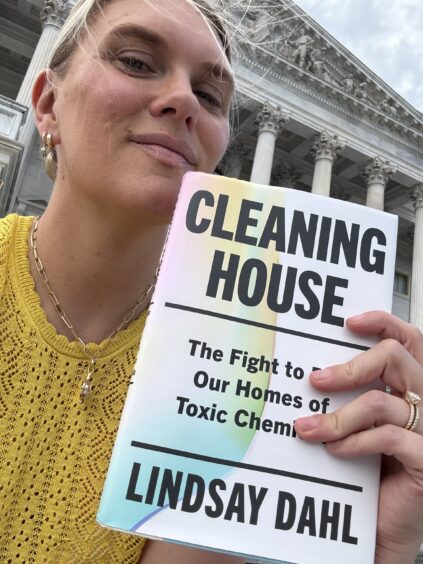
Last fall, our team at The Good Trade passed around a copy of “Cleaning House: The Fight To Rid Our Homes of Toxic Chemicals” by Lindsay Dahl — and it quickly became one of those books we couldn’t stop talking about. Grounded, personal, and deeply researched, it offers a clear-eyed look at the toxic chemicals woven into our everyday products, along with practical, empowering ways to lower our toxic burden. It’s equal parts memoir and call to action, blending lived experience with policy insight in a way that feels both accessible and galvanizing.
“In ‘Cleaning House,’ Lindsay pulls back the curtain on how these chemicals persist in our homes — and what it will take, collectively and individually, to create safer systems.”
Lindsay is a longtime environmental health advocate and policy leader who has helped shape state and federal efforts to reduce harmful chemicals in consumer goods. Today, she serves as Chief Impact Officer at Ritual, continuing her work at the intersection of transparency, science, and public health. In “Cleaning House,” Lindsay pulls back the curtain on how these chemicals persist in our homes — and what it will take, collectively and individually, to create safer systems.
We’re honored to sit down with Lindsay and have her answer a few of our burning questions, opening the dialogue to our community as we explore what it means to advocate for healthier homes, more transparent brands, and a future rooted in prevention.
Those who’ve read “Cleaning House” know that your personal story makes up a large part of the narrative. For those who haven’t yet, can you share the moment in your own life that pushed you to dive deeper into the world of toxic chemicals and product safety?
“The issue of toxic chemicals can feel overwhelming or dry, and I wanted the book to be the opposite of that: Easy to read, fast-paced, and read like a real story (it is!).”
The issue of toxic chemicals can feel overwhelming or dry, and I wanted the book to be the opposite of that: Easy to read, fast-paced, and read like a real story (it is!). I share how, when I started my career, I knew I wanted to work to protect the environment, but I quickly learned that not everyone was as passionate about protecting ecosystems as I was. An early job out of college helped me see that when you pass laws that protect human health and the environment, you win on a large scale. That type of change was very interesting to me, and I built a niche skill set focused on passing laws that address toxic chemical pollution in our air, water, and consumer products. I also found that by connecting the environment outside our homes to the products in our homes, more people were interested in learning and having a conversation. Twenty years later, I’m proud to say I’ve helped pass over 30 state and federal laws, all of which passed with bipartisan support.
The book details how your lobbying and organizing have led to major legislative wins. Which accomplishment are you most proud of, and why?
I’ll pick two if you let me! The work a large group of people did to pass updates to our primary toxic chemical law (TSCA) in 2016 is what I’m most proud of. We spent years building bipartisan support across people from all different backgrounds, and the updates created much-needed policies that led to the EPA finally setting a ban on asbestos, TCE, and methylchloride. Right now, these safety laws are under attack in DC, and I hope we can raise a bunch of noise to let Congress know they can’t roll back toxic chemical laws.
Second, when I was at Beautycounter (now Counter), we spent nine years asking Congress to update laws overseeing the toxic chemicals used in beauty and personal care products. We helped pass the largest update to cosmetic safety laws since the 1930s. While there is still so much work to be done for safer cosmetics, it was a huge step forward and one we should all be proud of.
You’ve been involved in the clean living movement for about 20 years. How has your perspective evolved since you first started this work? What do you think is most important for this movement today?
“The biggest challenge the clean living movement faces today is misinformation online. “
The biggest challenge the clean living movement faces today is misinformation online. I wrote a book about toxic chemicals, but I end up talking mostly about how the most toxic thing in our homes is social media. I see how the conversation has quickly shifted from a common-sense, product-safety topic to one that is quickly and unfairly labeled: “pseudo-science”. The overstating of claims about toxic chemicals by influencers has created a backlash, and the issue of environmental health has been weaponized for political gains. Both are solvable, which is what I speak to in my book. I think the largest shift in the last 20 years is overall consumer awareness. When I first started working on these issues, no one had any background on why plastics may be unsafe, or even questioned anything on the shelves. The goal now is to parlay that widespread consumer knowledge away from just shopping for safer products, but to pass large laws that help take the job of spotting the toxic chemical off of our very busy to-do lists.
What made you decide to write this book now?
I wrote “Cleaning House” because it has become very complicated to discern what is real science versus fearmongering. The enemy used to be clear; the chemical industry was using doubt around science as a tool to protect their market, like in the case of flame retardants, lead, PFAS, or plasticizer chemicals like BPA and phthalates. Now, misinformation is being shared — using the same talking points the chemical industry did for decades — by social media influencers. In a world of misinformation, I wanted to give people a solid grounding in how strong the scientific literature is about toxic chemicals, so they don’t dismiss the topic. And I also wanted to let people off the hook in feeling like they needed to take this on and shop their way to safety, which is impossible.
“I wrote ‘Cleaning House’ because it has become very complicated to discern what is real science versus fearmongering.”
I think we have a huge opportunity to shift the conversation away from an individualized approach of “clean living” to look at the systemic shifts of toxic chemicals, far beyond a consumer product. I want people to start to understand that communities living in the U.S. next to chemical and plastics facilities are being impacted by the development of these chemicals. Strong science shows us both that exposure via products in our homes is also an issue. And that when products leave our homes and are incinerated, there are lasting impacts on communities and ecosystems.
The time is to shift away from considering just the impacts of toxic chemicals in our homes and think with a more global perspective.
For someone starting to think about what they bring into their home and put in/on their body, what are the simple, small shifts to start with? Are there categories that are more important to focus on?
I’ll give you my top categories and tips (and there is a helpful section at the end of my book that outlines all my consumer tips!):
- Kitchen: Switch cookware to stainless steel or cast iron. Opt for Clean Label Project certified supplements & protein powder (Ritual — where I’m the Chief Impact Officer — is my favorite!). Avoid takeout when possible, as many containers are coated in PFAS, known more commonly as “forever chemicals.” EPA Safer Choice is a great certification for household cleaners, and filtered tap water is best!
- Beauty: Look for EWG-verified or MADE SAFE-certified brands. Shop at Credo if you’re looking for a one-stop shop. My favorite brands include Counter, OSEA, Dr. Bronner’s.
- Furniture/Home: Look for flame-retardant-free couches and mattresses. When doing home renovations, avoid flame retardants and PFAS materials (commonly used in carpet padding, carpets, ‘stain-resistant’ finishes on couches, etc).
What is your advice on how to remain engaged without feeling discouraged?
I have the benefit of seeing all of the positive impact of our choices in the marketplace and our laws, so staying hopeful is relatively easy for me. If people pull back from turning this issue into a rabbit hole of control and consumer choice, we can all tap into the momentum that happens when we pick up the phone and tell Congress no more rollbacks to toxic chemical laws! Or seeing the evolution of offerings in the market, 20 years ago, the only option for a flame-retardant-free couch was to have one custom-made; now they’ve been in the IKEA showroom for years at affordable price points.
“If people pull back from turning this issue into a rabbithole of control and consumer choice, we can all tap into the momentum.”
What’s one myth about nontoxic living that you hope readers let go of after reading your book?
That it’s all on you to solve this problem. I encourage people to make smart choices and where they can purchase products from brands making safer products. But I want people to know that our collective power to pass meaningful, large-scale laws banning these toxic chemicals is actually where the solution lies. And as it turns out, picking up the phone is a lot cheaper than buying a new mattress or cookware.
What are your favorite, trustworthy resources for people trying to make safer choices?
I sit on the board of Toxic Free Future and trust their work on the state and federal policy work. I encourage people to follow NRDC and Breast Cancer Prevention Partners for a meaningful translation of the science around toxic chemicals. And people can buy my book and subscribe to my Substack, where I bring a balanced approach to breaking headlines: Science, Politics, Culture of Wellness.
What gives you hope right now about the future of clean living and a safer world for all of us?
The bipartisan nature of this issue is really energizing to me. Consumer safety laws at the state and federal levels have been supported by both parties for decades.
“I encourage all of us, regardless of our preferred political party, to hold ALL politicians accountable.”
Right now, we have a bigger, complex conversation happening at the federal level about environmental health, and sometimes the rhetoric lines up with the science, and sometimes it doesn’t. I’m watching with a cautious eye, and I encourage all of us, regardless of our preferred political party, to hold ALL politicians accountable. We can’t allow any more rollbacks to our existing laws on toxic chemicals. This is one of the many metaphors that “cleaning house” represents.
We must talk openly about these nuances if we want to win long term. I am putting my confidence in the fiery and smart group of bipartisan moms who have led the way on this issue for the last several decades.
Ashley D’Arcy is the Senior Editor at The Good Trade. She holds an MA in Philosophy from The New School for Social Research and has contributed to esteemed outlets such as The Nation, 032c, and Yale School of Management’s Insights where she’s leveraged her expertise in making complex ideas accessible to a broad audience. In addition to her editorial work, she is training as a psychoanalytic mental health professional and provides care to patients in New York City. Ashley also explores sustainable fashion, clean beauty, and wellness trends, combining thoughtful cultural critiques with a commitment to mindful living.