

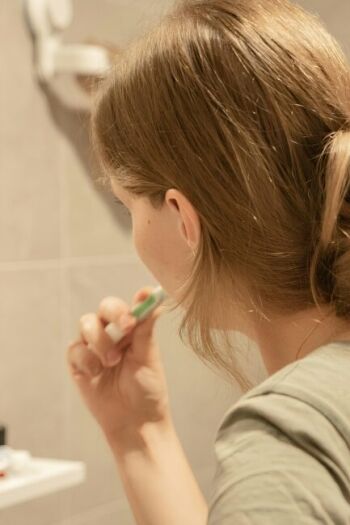
Understanding The Mouth-Body Connection

I have a thing for antiseptic mouthwash. And not in a good way.
It’s generally the first thing I remove from a client’s bathroom during a wellness audit. I’ve been known to actually pour it down the drain.
Am I being dramatic? Maybe. But once you know the truth, you realize that in our well-intentioned quest for better hygiene, we are working against our biology. In particular, our oral microbiome.
“In our well-intentioned quest for better hygiene, we are working against our biology. In particular, our oral microbiome.”
As a health strategist, it’s my job to assess the efficacy of wellness products for my clients — including a deep dive into ingredients, formulations, and claims. Out of all the categories, dental care is in dire need of a reinvention. The current selection of conventional mouthwash and toothpaste is a reflection of what happens when a false narrative is so widely spread that it becomes the norm, even if the intervention is not grounded in science.
Contrary to popular belief, your mouth doesn’t need to tingle with the scent of cool mint. Nor does it need to be sanitized with an antimicrobial, antiseptic, or alcohol-based power wash — except in the rare case of a serious infection or doctor’s orders for post-surgery recovery.
Your mouth is a delicate ecosystem and one of the most microbially dense in the body. Wiping it out twice a day in the name of being “clean” is counterproductive and potentially harmful.
So what is an oral microbiome?
In 2020, I was working as a Chief Marketing Officer with a team of microbiologists conducting research on the gut and skin microbiomes. While I was learning about the importance of microbes to our immune system and our interconnected relationship with our environment, the world was sanitizing every body part and surface they touched in the name of safety.
What science knows that hasn’t been fully adopted by the wellness industry is that not all bacteria are bad. Some exist to keep you healthy. Understanding this fundamental part of our body’s natural defense system changed my approach to personal hygiene and fueled my curiosity towards root cause medicine.
By now, most of us have heard of the gut microbiome, but did you know the human body hosts distinct microbial communities across dozens of sites? The four most studied are gut, mouth, skin, and vagina.
“Did you know the human body hosts distinct microbial communities across dozens of sites?”
The oral microbiome is defined as a community of bacteria, fungi, viruses, and other microorganisms that live in your mouth, known as the second most microbially dense environment after the gut. According to the Human Oral Microbiome Database (HOMD), the mouth is home to roughly 700 known species that colonize every surface, including your teeth, tongue, roof of your mouth, and even the inside of your cheeks.
Think of your oral microbiome as a garden. A balanced one protects you, while an unbalanced environment is the root of issues like cavities, bad breath, and gum disease.
Our built-in gatekeeper
Your mouth is the front door to your body. It’s exposed to food, drink, air, viruses, and whatever else comes close to it. The tissue that lines the entryway, called the oral mucosa, is an extraordinary layer that is both intelligent and has a memory. It’s also a very thin border between the outside world and your bloodstream.
It’s a big job that the mucosa cannot do on its own, so it relies on the millions of beneficial microbes living on its surface to help it decide what belongs in your body and what does not. Amazingly, the microbes in our mouths can both stimulate and suppress the immune system.
“The microbes in our mouths can both stimulate and suppress the immune system.”
The mucosa works like the ground cover in a well-tended garden, occupying the soil so weeds can’t take root. When the cover is compromised for various reasons, pathogens can move in and take hold of the empty space. This causes chronic inflammation, which is the beginning of many diseases that we try so hard to reverse.
What does your oral microbiome actually do?
Your oral microbiome is quietly working 24/7 on your behalf, powered by saliva.
Saliva is one of the most underrated fluids in the body. We think about it as something that helps us chew our food. Healthy saliva is 99% water and rich in calcium and phosphate, the exact minerals your enamel needs to rebuild itself and prevent cavities. It’s also the medium that carries the microbiome, buffers the pH of your mouth, and delivers protective compounds.
“Healthy saliva is 99% water and rich in calcium and phosphate, the exact minerals your enamel needs to rebuild itself and prevent cavities.”
Together, the microbiome and saliva are doing more than you realize. This dream team:
- Starts digestion. Breaks down carbohydrates and other compounds before food ever reaches your stomach.
- Produces nitric oxide. Converts nitrates from leafy greens into a compound that relaxes your blood vessels and supports healthy blood pressure.
- Trains your immune system. Teaches your body to distinguish real threats from harmless ones.
- Blocks pathogens. Produces natural antimicrobials that prevent aggressive bacteria from spreading.
- Feeds the gut. Every time we swallow, we send oral microbes downstream. A balanced mouth sends beneficial reinforcements.
- Supports cardiovascular and brain health. Research is linking oral bacteria to stroke and cognitive decline.
When any of these important tasks break down — whether from dehydration, harsh oral care products, or hormonal changes from menopause — the whole system is compromised.
Everything we thought we knew about cavities
As children, we were taught that sugar rots teeth and brushing prevents cavities. When we go for a cleaning, we get lectured about the importance of flossing. While all of this is true, it’s not the whole story.
This is why some patients with meticulous routines, including flossing, still develop cavities — while others with more lax habits annoyingly do not. Consistent oral hygiene matters, but so does the type of bacteria living in our mouths and in what proportion.
“Consistent oral hygiene matters, but so does the type of bacteria living in our mouths and in what proportion.”
So what determines the healthy or harmful bacteria in our mouths?
Our oral microbiome was seeded by our mothers at birth, and from there it’s impacted by diet, hydration, salivary flow, stress, and medication. The oral care products we use are simply a response to our changing needs, but they don’t address the root cause.
Unknowingly, we may be compromising the healthy microbes designed to maintain balance in our mouths by our modern diet and lifestyle, including the onslaught of medicated mouthwash and sudsy toothpaste. Our routine could be causing more problems than we realize.
“Our routine could be causing more problems than we realize.”
According to Dr. Eve Lofthus, a San Francisco dentist who founded the innovative new dental care range, Evenmouth, we have been approaching oral health in the wrong way.
“I think what’s really fascinating is for a lot of people, their cavities and gum issues are not because they aren’t brushing,” Dr. Lofthus explains.
“The oral bacteria that cause bad breath or cavities, for example, are out of balance in your mouth. So no matter how good your hygiene is, what repopulates each day could still be shifted toward more cavity-causing bacteria, more bad breath-causing bacteria. It’s actually just a balance of your bacteria problem.”
We’ve been sold the idea that a clean mouth is a sterile mouth. But our dental issues are largely a modern-day problem, and decay, inflamed gums, and bad breath are symptoms of an underlying imbalance, not a sign to reach for another product.
When we understand that our mouth is the gateway to the body, we realize that it’s not a closed system. The oral mucosa is porous and selectively permeable, which means that it can let bacteria enter the bloodstream. The health of the oral cavity is intimately intertwined with the health of the whole body.
The 6 bad habits affecting our oral health
Both Dr. Lofthus and I see the same modern-day habits with our clients that contribute to their dental issues and overall health. This is what we’ve seen causing problems for oral health:
All day grazing
The frequency of our snacking is a big problem. Every time we eat, the bacteria in our mouth also eat, and shift the pH (how acidic our mouth is) into a zone of demineralization. If we are frequently snacking, our saliva doesn’t get the chance to buffer that pH into a zone for remineralization. A low pH is very destructive to the teeth and fosters more of those acid-tolerant (cavity-causing) bacteria.
Drinking alcohol
Research shows that daily drinking, even at moderate levels, decreases microbial diversity, dries out the mouth, disrupts saliva production, and shifts the oral microbiome towards bacteria that cause gum disease and bad breath. Wine, because of its acidity, is particularly hard on enamel.
Constant stress
We know that stress diverts resources away from anything that it doesn’t consider essential to your survival. Producing saliva is one of those things. Your saliva becomes thicker and more acidic, which lowers the protective compounds that your mouth needs to keep bacteria in check.
Dehydration
Many of us are chronically dehydrated. Healthy saliva is made of 99% water. When dehydrated, your mouth can’t transport those minerals to your teeth effectively. Water content really matters for optimal remineralization of our teeth.
Sleep issues
Often chronic sleep issues are actually breathing issues like apnea, snoring, and mouth breathing. When the mouth dries out during the night, it creates an environment where teeth are not protected by saliva and are more prone to decay.
Antiseptic mouthwash
Mouthwash is generally unnecessary, but many people love the convenience and feeling of the swish. Unfortunately, conventional mouthwash with any antimicrobial action, even essential oils, can cause disruption of the plaque biofilm.
A better oral care toolkit
The good news is that shifting your oral routine is one of the highest return upgrades you can make. Here are some of the products that I recommend to my clients looking for a better way to support their health.
- Evenmouth toothpaste is a rigorously formulated microbiome-supporting toothpaste, created by Dr. Lofthus. The hero ingredient is a postbiotic called S. Dentisani 7746, discovered in the mouths of people who have never had a cavity. The formulation excludes many of the common conventional ingredients found in dental products that disrupt the ecosystem, including SLS, titanium dioxide, and artificial flavors.
- The Suri Electric Toothbrush is a gentle-bristled, sonic brush with a replaceable head made from cornstarch and a repairable body designed to last. It holds a charge so you can take it traveling.
- A copper tongue scraper is one of the simplest and most inexpensive additions to your oral care routine. A lot of the volatile compounds behind bad breath live on the back of the tongue, and scraping in the morning is the fastest way to reduce them.
- Mouth tape is helpful if you are a mouth breather at night. Taping your lips closed with a gentle, skin-safe tape retrains you to breathe through your nose. Your oral tissue stays hydrated because your saliva doesn’t dry out while you sleep. As a bonus, your sleep quality often improves.
- Helio Red Light Device is a new intervention, but there is some emerging data around red light therapy as a way to support gum tissue and to calm inflammation in the oral cavity. Worth a try if it keeps the drill away.
Feed the ecosystem
Remember that running to the oral care aisle is only half of the equation. It’s important to return to what we know now about the oral microbiome — that feeding the microbes from the inside out will improve your defenses.
“Feeding the microbes from the inside out will improve your defenses.”
Eat more nitrate-rich leafy greens. Support your oral microbiome with arugula, spinach, and Swiss chard, which fuel the good bacteria that create nitric oxide.
Prioritize whole food polyphenols. Eat berries, green tea, extra virgin olive oil, and even dark chocolate, which support beneficial oral bacteria.
Add fermented food for your whole system. Your mouth and gut microbiomes are in constant contact, so feeding the good bugs with sauerkraut, yogurt, and miso helps both.
Supplement with D3 and K2. These two vitamins work together to direct calcium into your bones and teeth instead of your arteries, especially during perimenopause, when levels decline.
Your oral microbiome is one of your most powerful immune allies if you tend to it properly. Think about nurturing your garden to promote overall health instead of plowing through it, just to pull a few weeds.
Celia Chen is a health strategist who coaches high-performing women in midlife on body composition, menopause and longevity. A former wellness CMO and 28-year luxury brand executive, she’s the founder of Chenessa, a health advisory for private and corporate clients. Get her free Health Spending Decoder™, a step-by-step performance review of your wellness routine. Follow her on Substack and Instagram.


