

Why I Chose Bobbie Formula For My Daughter (2026 Review)

I always assumed feeding a baby was an either/or decision: Breast milk or formula. In my mind, the two lived on opposite ends of a spectrum, and choosing one meant closing the door on the other. Growing up, I’d heard stories that reinforced that divide, like how when I was an infant, a well-meaning relative gave me a bottle of formula without my mom’s permission, and after that, I supposedly refused to nurse again. Whether or not that story is entirely accurate, it shaped how I understood feeding: Formula was something you turned to only when breastfeeding didn’t work out.
“I always assumed feeding a baby was an either/or decision: Breast milk or formula.”
So when I became pregnant after years of IVF, I didn’t think much about how I’d feed my baby. After everything it took to get to that point, feeding felt like the easy part. I figured I’d try breastfeeding, and if it didn’t work, I’d use formula. Either way, the baby would be fed, and that’s what mattered.
What I didn’t expect was that breastfeeding would come easily. My baby latched, my milk came in, and it all felt manageable (magical, even). But after a few weeks, the exhaustion began to take over. I felt anxious leaving the house — pump in tow — and was constantly watching the clock until the next feed. Worst of all, I felt guilty because I knew I should have been more grateful for how well breastfeeding was going. Instead, I felt overwhelmed by the constant demand.
“I felt overwhelmed by the constant demand. That’s when I started thinking about formula — not because I needed to, but because I wanted to.”
That’s when I started thinking about formula — not because I needed to, but because I wanted to. I realized that supplementing could be a way to care for myself as much as for my baby. Adding a bottle to the mix meant I could sleep longer. My husband could help with night feeds. I could be away from the house for more than an hour without panicking. It was a small shift, but one that changed everything.
At first, I worried what that would mean. Was I giving up too soon? Would my milk supply drop? Would my baby refuse to nurse? But the more I learned, the more I understood that combo feeding — using both breast milk and formula — wasn’t about failure. It was about flexibility. And that flexibility became essential for my mental health and my ability to enjoy early motherhood.
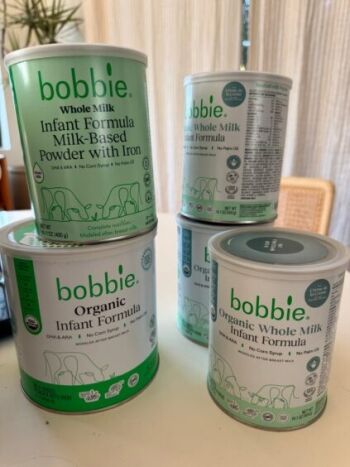
Of course, finding the right formula wasn’t simple. My baby was incredibly gassy and spit up constantly — whether it was breast milk or formula, we were doing a lot of laundry. We tried a few different brands, even goat milk formula (which, I can confirm, smells exactly like a petting zoo). Eventually, we found Bobbie, and it’s been the best fit for us ever since.

Why we landed on Bobbie
Bobbie is an organic, European-style infant formula made in the U.S., designed to be as close to breast milk as possible in nutrition and composition. What drew me in first was the ingredient list — no corn syrup, no palm oil, and milk sourced from pasture-raised cows on organic farms. It’s also the only U.S. formula brand to meet both FDA and USDA Organic standards.
“Bobbie is an organic, European-style infant formula made in the U.S., designed to be as close to breast milk as possible in nutrition and composition.”
“At Bobbie, when we say ‘organic,’ we’re not just talking labels,” explains Mallory Whitmore, Bobbie Education Lead and ‘The Formula Mom.’ “Meeting USDA Organic standards–the strictest in the world–while also aligning with many European nutrition guidelines means no GMOs, synthetic pesticides, hormones, or shortcuts.”
Bobbie openly shares where its ingredients come from and how its formula is made. For example, its proprietary oil blend is sourced from a five-generation family farm in California. As a parent, that matters. I spent years researching every supplement and ingredient during IVF and pregnancy, so it only made sense that I’d want to know exactly what I was feeding my baby.
I also love the ethos behind Bobbie as a company. It’s the first mom-founded and led infant formula brand in the U.S. “Bobbie has shown up differently for parents from day one — because we are parents ourselves,” shares Whitemore. “We not only feed Bobbie to our own babies, we’re going through our own parenting journeys alongside our customers and that layer of empathy is woven into everything we do.”
Bobbie isn’t just making clean formula; the company is helping change parenting culture by advocating for paid leave, raising awareness about the maternal mortality crisis, and so much more through the impact arm of the business, Bobbie for Change.
But beyond all that, Bobbie simply works for us. My daughter doesn’t just tolerate Bobbie; she actually likes it. And she has noticeably less gas and fewer spit-ups. It mixes easily, doesn’t have the cloying sweet smell that some formulas do, and makes our feeding routine feel seamless.
What combo feeding looks like for us
As a combo feeding family, our rhythm feels balanced. I nurse and pump during the day, and we use Bobbie for night feeds. My husband handles those middle-of-the-night bottles, and I get the kind of rest that keeps me grounded and patient the next day. I don’t worry about leaving the house or scheduling around every feed. I don’t feel like I’m constantly running on empty.
“In a culture that often emphasizes ‘exclusive breastfeeding,’ choosing to combo feed has felt like giving myself permission to define what works best for our family.”
In a culture that often emphasizes “exclusive breastfeeding,” choosing to combo feed has felt like giving myself permission to define what works best for our family. It reminded me that nourishing a baby isn’t only about milk; it’s about creating a sustainable system that works.
“We found that 70% of formula-feeding parents are combo feeding, and 84% of those parents said it helped extend their breastfeeding journey,” explains Whitmore. I hadn’t realized how common combo feeding actually is — but it turns out, it’s a model that works beautifully for many families.
Breast milk is incredible. Formula is too. What matters is that both can coexist. “There is an overused assumption in feeding culture that it’s either breast OR bottle, but we know that for most parents, it’s both,” says Whitemore. “[At Bobbie] we’re focused on bringing parents together rather than pitting them against one another. If all parents, no matter how they feed, feel undeniably good about their feeding journey, then we’ve done our job.”
I used to think choosing formula meant something had gone wrong. Now I see it as one of the best choices I’ve made as a new parent because it’s allowed me to show up rested, confident, and present. And in the end, that’s what both of us need most.
This story is in partnership with our friends at Bobbie
Kayti Christian is a Senior Content Strategist at The Good Trade. With an MFA in Nonfiction Creative Writing, her work has appeared in TODAY, Shondaland, and The New York Times. Since 2017, Kayti has been uncovering and reviewing the best sustainable home brands and wellness products. Her personal journey through four years of fertility treatments has inspired her to write extensively about women’s healthcare and reproductive access. Beyond her work at The Good Trade, Kayti is the creator of phone notes, a Substack newsletter with 7,000 subscribers, and the cohost of the FriedEggs Podcast, which delves into IVF and infertility.


