

What’s The Difference Between Dunlop And Talalay Latex?

We get it. Shopping for bedding and other sleep products can be a lot. It’s hard to get pure, unbiased information, and these are often big-ticket items. And to make matters harder, your sleep and bedroom products are probably the number one area of your life where you might want to invest in clean, nontoxic goods made from natural (not synthetic) components.
So here’s one question we encounter often: What is the difference between Dunlop and Talalay latex?
“In short, the difference between Dunlop and Talalay lies in their processes.”
In short, the difference between Dunlop and Talalay lies in their processes. While they’re both made from the same material (rubber), Dunlop is denser and more supportive, and Talalay is lighter, softer, and more contouring. They both have their strengths, and they’re both great for different products or use cases.
Below, we dive into what sets these two types of latex apart, what they’re each good for, and what you should keep in mind when purchasing.
What is latex?
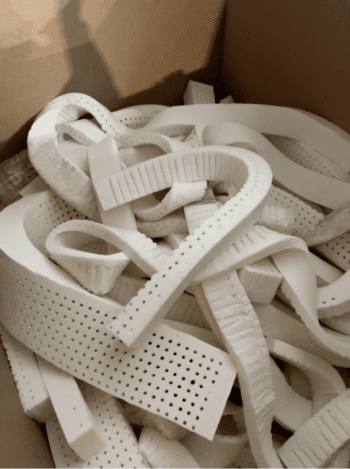
Let’s start off with what latex is in the first place. Latex is the soft, springy foam that is made from the milky sap of rubber trees. This sap is collected from trees, filtered, treated with acid to form solid curds, then processed according to how it’ll be used — pressed into blocks of solid, bouncy rubber latex if bedding is the end goal.
“Latex is the soft, springy foam that is made from the milky sap of rubber trees.”
In bedding, latex is valued for its natural resilience, which supports the body while still feeling cushiony. Latex is also used to make countless other products — durable and stretchy household goods like gloves, balloons, elastic waistbands in clothing, adhesives, condoms, and other medical and healthcare goods.
In mattresses and pillows, latex is often used as a layer or core because it responds quickly to movement and helps distribute weight evenly. It’s popular for people who want pressure relief without the “sinking in” feeling of memory foam. Latex mattresses are also known for being more breathable than synthetic alternatives like memory foam. This means air moves through the material, keeping sleep surfaces cooler.
Synthetic latex, made from petroleum-based compounds, is cheaper to produce than natural rubber latex, so you’ll often find this in budget-friendly mattress options. In general, synthetic latex materials are stronger, while natural latex is softer. And many latex products are blends of both natural and synthetic latex, both for affordability and to change the feel of the final product.
What is Dunlop latex?
Dunlop latex comes from a straightforward process that includes whipping the liquid rubber sap and baking it so it becomes a firm, solid foam. It’s often compared to pound cake. This process was developed in 1929 and is the simplest, most energy-efficient way of making latex. Dunlop can be made with different firmness levels, which is why not all Dunlop feels exactly the same — but it tends to always be firmer than Talalay.
“Dunlop can be made with different firmness levels, which is why not all Dunlop feels exactly the same — but it tends to always be firmer than Talalay.”
This method tends to result in a latex that’s denser on the bottom and softer towards the top, as heavier particles settle towards the bottom during baking, making this an excellent support layer in mattresses. For this reason, it’s usually less breathable than Talalay latex.
How Dunlop latex is made
Dunlop latex is made by whipping liquid rubber sap to an airy, foamy consistency, then mixed with sulfur or other accelerators. The liquid is then poured into molds and heated to a high temperature in a vulcanization oven. (Fun fact: Vulcanization was invented by Charles Goodyear in the 1840s, initially for making rubber tires!)
“Fun fact: Vulcanization was invented by Charles Goodyear in the 1840s, initially for making rubber tires!”
Liquid latex is then solidified into a durable substance with the application of both sulfur and heat. The baked and firm latex is then washed to remove impurities and subjected to heat again to make sure all moisture is gone from the final product.
Some Dunlop latex products we love
Some of our favorite latex mattresses and pillows are made with Dunlop latex for comfortable, firm support. PlushBeds’ Botanical Bliss Organic Latex Mattress has a Dunlop core on the bottom for a supportive base. Avocado also uses a base of GOLS or FSC certified Dunlop in most of its mattresses, like its Avocado Green Mattress and its Luxury Organic Mattress.
“Some of our favorite latex mattresses and pillows are made with Dunlop latex for comfortable, firm support.”
Earthfoam uses the Dunlop process to make the latex foam for their mattresses, which are primarily a solid slab of springy, supportive Dunlop latex. And Coyuchi’s Organic Latex Molded Pillow is made with pure Dunlop latex for a durable, supportive pillow that’s great for side sleepers.
What is Talalay latex?
Talalay latex is softer, bouncier latex with more give to it. That’s because it’s created with a special process that adds more air into the latex, which makes the final product more breathable.
“Talalay latex is softer, bouncier latex with more give to it.”
Because it’s slightly lighter and more fluffy, but still more supportive than most foams, you’ll find Talalay used in organic firm pillows and organic mattress toppers. This type of latex also has a more homogeneous consistency, unlike Dunlop, which is denser on the bottom.
How Talalay latex is made
“Talalay latex starts with a process similar to Dunlop’s — rubber sap is harvested, whipped, and mixed with other ingredients like sulfur.”
Talalay latex starts with a process similar to Dunlop’s — rubber sap is harvested, whipped, and mixed with other ingredients like sulfur. This liquid latex is poured into a mold for vulcanization, but filled only partially. The mold is vacuum-sealed so the liquid latex expands to become fluffier, then freeze-dried as carbon dioxide is pushed through to begin to gel.
Finally, the latex is vulcanized in a hot oven, washed clean, and dried again. First introduced around the 1940s, the Talalay process is more involved and energy-intensive but results in a more buoyant, conforming final product.
Some Talalay latex products we love
Birch makes their mattresses with natural, sustainably harvested Talalay latex — and they make a Talalay Latex Pillow, too. Nolah uses a layer of Talalay in its hybrid latex mattress for added comfort and support.
Avocado’s Eco Organic Mattress Topper comes in a plush Talalay option along with a firmer Dunlop version. Unlike their mattresses, which are made with Dunlop, Earthfoam’s pillows are made with Talalay latex for a softer, bouncier feel.
Dunlop vs. Talalay latex: Which one is better?
When it comes to choosing between Dunlop and Talalay, there is no right answer. In fact, the difference in feel between the two final products is not huge at all. But generally speaking, you tend to find Dunlop used more for mattresses because it’s more supportive, and Talalay used for more pillows and mattresses toppers because it’s softer.
“You tend to find Dunlop used more for mattresses because it’s more supportive, and Talalay used for more pillows and mattresses toppers because it’s softer.”
The type of latex you keep an eye out for when shopping depends on your preferences and budget. Dunlop tends to be more affordable since it’s less intensive to manufacture (and it has a lower energy footprint for this reason, too!). If you’re a back or stomach sleeper, you might prefer the support of Dunlop, while if you’re a side sleeper, you might want the bounciness of Talalay.
Talalay also feels more breathable because of its airiness, which is great for hot sleepers. Dunlop, on the other hand, is known for being more durable because of its higher density.
“Dunlop” versus “Talalay” designations are not the end-all, be-all of sleep shopping — they’re just another small factor to consider. Note that each type of latex can be made in different firmnesses — you could have a relatively soft Dunlop, or a relatively firm Talalay. And you’ll see Talalay used in some mattresses (typically more luxury ones), and you’ll see Dunlop used in some pillows and toppers. In some products, the latex is even shredded, like in this Saatva pillow, and then it becomes super difficult to tell the difference between the two types! There are no hard and fast rules.
In any case, latex of any kind is produced from natural materials and has exceptional breathability, springy support, and durability when compared to synthetic foams like memory foam or polyurethane foam. For this reason, we always prioritize latex when shopping for bedding — it tends to be worth the investment.
Natalie Gale is a Boston-based freelance journalist. Since 2022, she has been reviewing the top sustainable home, wellness, fashion, and beauty products, sharing her honest opinion on the best finds. When she’s not writing about art, food, or sustainability, you can find her biking to the farmers’ market, baking, sewing, or planning her next Halloween costume. Say hi on Instagram!


