When Is It Actually Worth Buying The Expensive Version? We Did The Math

When I was 19, I saved up $600 for my very first camcorder before a big trip abroad. I was convinced I’d be a documentary filmmaker, and a camera felt like the first real step toward that dream.
It was the most expensive thing I’d ever bought. I was waiting tables while paying my way through community college, and I still remember sitting on my bedroom floor, sorting tips into piles: gas money, my phone bill, groceries, and the camera. It was the first time I thought of a purchase as an investment, and looking back, it shaped how I think about money today.
Don’t save money on the wrong end, a friend once told me. It’s become my mantra, and I think about it every time I make a big purchase. And for me, it’s never been only about the price tag. It’s also about my health, my comfort, and how I feel using something every day.
“For me, it’s never been only about the price tag. It’s also about my health, my comfort, and how I feel using something every day.”
That said, money is a sensitive subject, especially in this economy. My husband and I are raising a toddler, preparing for another baby, and paying Los Angeles prices for groceries and diapers. I know that saving for something expensive is a privilege many of us can’t afford right now. But I’ve also learned, sometimes the hard way, that the cheapest option can cost more over time, especially with appliances and larger home items.
If you’re shopping for big-ticket items this Black Friday and Cyber Monday, I hope this piece helps you figure out which purchases are worth the splurge. Cost per use is a helpful place to start, but our health, comfort, the materials we live with, warranties, and the joy something brings to our lives matter, too. Whether it’s a camcorder for your next big trip or a washer to replace the one that’s been leaking for a year, here’s where spending more now can pay off in the long run.
Where spending more is worth it
Mattresses, pillows, and bedding
Throughout my twenties, I cycled through IKEA mattresses and no-name toppers from Amazon, hoping each new addition would finally make my bed comfortable. Then, six years ago, Avocado sent us a Green Mattress to test for a review. Believe me when I tell you this mattress has become an extension of my body! I can’t imagine sleeping without it.
It’s since moved with us to three apartments and, most recently, into the house we bought. This mattress has been essential during seasons of life when rest was of the utmost importance — I’ve never regretted a single penny spent on it. It’s supported me through an IVF journey, two extremely uncomfortable pregnancies, sleepless newborn nights, and seasons of deep exhaustion and grief.
“This mattress has been essential during seasons of life when rest was of the utmost importance — I’ve never regretted a single penny spent on it.”
For my husband, a notoriously picky sleeper and a firefighter who works 24-hour shifts, it’s given him rest through training academies and probationary years. And here’s the kicker: It’s still as comfortable, and looks exactly the same, as the day it arrived.
The math:
At its regular price of $2,999, a king Avocado Green Mattress that lasts a decade costs about 82 cents a night. Replacing a $399 IKEA mattress every two to three years adds up to roughly $1,600 to $2,000 over the same 10 years, or about 44 to 55 cents a night, before counting the toppers I kept buying to make those beds bearable.
“Waking up without aches, skipping the chiropractor, and feeling good about the materials I breathe in for eight hours a night — that’s worth a little more to me.”
On paper, the cheaper bed wins by about 30 to 40 cents a night, or roughly $100 to $140 a year. But Avocado backs the Green Mattress with a 25-year limited warranty, and if ours makes it to 20 years, it drops to about 41 cents a night, right in line with the IKEA cycle. What the math doesn’t capture: Waking up without aches, skipping the chiropractor, and feeling good about the materials I breathe in for eight hours a night — that’s worth a little more to me.
Bedding is closer. Fifty-dollar sheets that wear through in one to two years mean five to 10 sets over a decade, or $250 to $500. A $318 organic percale set from Coyuchi that holds up to years of washing costs about the same (or less on sale), and it gives you peace of mind about the materials you’re sleeping on every night.
Pillows are where the case is less about money and more about health. Polyester pillows typically need replacing every six months to two years, while an organic latex-and-kapok pillow like Avocado’s Green Pillow ($179 for a king) can last three to five years, or longer. I’m still sleeping on one I bought when we got our new mattress, and it’s just as supportive as the day I received it!
“Pillows are where the case is less about money and more about health.”
Over a decade, a pair of Avocado pillows may cost a few hundred dollars more than cheap polyester ones, but you’re paying for nontoxic materials, real neck support, and better rest, not just monetary savings.
A sofa built to last
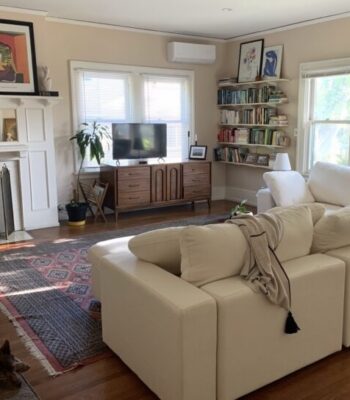
In my twenties, we had a revolving cast of Facebook Marketplace couches, most of them already on their last legs. (Truly, there were times we had to make new legs so they didn’t tilt!) They were what we could afford, especially since we moved frequently, and they served their purpose — secondhand can be really great for this!
“I felt nauseous when I hit “purchase” on a four digit price tag.”
That said, when I got my first “big girl” job out of grad school, we spent my holiday bonus on a brand-new sofa. I had just turned 30, it was peak COVID, and we basically lived on our couch. Still, I felt nauseous when I hit “purchase” on a four-digit price tag. But when the couch arrived (it was a Sabai loveseat), and I immediately understood the appeal of buying a new sofa.
The math:
A $2,500 sofa used daily for 12 years costs about 57 cents a day. Four $200 thrifted couches over that same stretch total $800, or about 18 cents a day. Cheaper on paper, sure, but add in truck rentals and deep cleans (not to mention the back support you lose to sagging cushions), and the gap narrows fast.
“Add in truck rentals and deep cleans (not to mention the back support you lose to sagging cushions), and the gap narrows fast.”
A well-made sofa also holds its value: secondhand Sabai sofas regularly resell for $350 or more, and we sold our loveseat for $700 on Marketplace when we were ready to upgrade to something larger. My only warning is to still look for reputable brands, warranties, and durable upholstery. A big price tag alone doesn’t promise quality.
Clothes you’ll wear for years
The Good Trade began as a response to fast fashion, and cost per wear is a helpful reminder of why quality matters. A $10 T-shirt worn 10 times costs $1 a wear, while a $40 shirt worn 100 times costs 40 cents a wear. These are illustrative numbers. Inexpensive clothes can last too, and some of my favorite T-shirts are actually from Target.
“A $10 T-shirt worn 10 times costs $1 a wear, while a $40 shirt worn 100 times costs 40 cents a wear.”
Still, I love the idea of a capsule wardrobe filled with clothes that fit me well, are made from sustainable and organic materials, and actually get worn, rather than constantly replacing things that weren’t quite right. That’s especially true for pieces that take a beating, like good shoes and jackets.
The little things we love
My OSEA lip oil recently ran out and went straight onto my Christmas list. At $28, it’s expensive for a tiny skincare product, but mine lasts more than six months with nightly use, or about 16 cents an application. Meanwhile, I couldn’t tell you how many $2 lip balms I’ve lost this year, but I promise you I always know where my OSEA is.
“I couldn’t tell you how many $2 lip balms I’ve lost this year, but I promise you I always know where my OSEA is.”
I have a theory that our psyche knows to take better care of the things we’ve invested in, which is why I’ve never lost my Oura Ring or my Warby Parker sunglasses. The $10 sunglasses I bought off Amazon, though? The cheap ring I bought to wear as a wedding band when my fingers were too swollen from pregnancy? Reward offered to whoever can find those.
Fresh coffee beans from our local shop cost more than the discounted ones online, but I drink less, savor each cup, and support a neighborhood business. Enjoyment and values matter, even when the savings aren’t obvious.
When I’d actually spend less
Having tested plenty of wellness gadgets, I’ve found that some expensive products don’t fit my routine as I anticipated.
We have Normatec compression boots, for example, which retail for $899. Used twice a month for a year, that’s about $37 a session, compared with a $100 yoga mat used three times a week, which comes to around 64 cents per use. They’re different products, but it’s a reminder to think about our actual habits rather than the ones we imagine we’ll have after buying something.
“It’s a reminder to think about our actual habits rather than the ones we imagine we’ll have after buying something.”
This is also an area where I’d opt for secondhand or to borrow from a friend. I love our Normatecs when I get the chance to use them, but I don’t use them enough to justify the price. Now we share them: the firefighters love them, so they rotate around the city, and we get them back when we need them, like when my husband is training for a triathlon.
Shopping Black Friday with intention
That camcorder purchase was almost two decades ago, but I still remember the excitement of finally buying what I’d spent months saving for. Black Friday can offer that same feeling, especially for big household purchases. When you know what you’re looking for, have compared your options, and find the version you love at a discount, that’s a reason to feel good about shopping.
“When you know what you’re looking for, have compared your options, and find the version you love at a discount, that’s a reason to feel good about shopping.”
If an organic mattress, a well-made sofa, or a beautiful piece of clothing has been on your list, do the math, check the materials, and enjoy the sale. There’s something wonderful about finally buying the thing you’ve saved for, especially when you know you’ll still love it five years later.
Kayti Christian is a Senior Content Strategist at The Good Trade. With an MFA in Nonfiction Creative Writing, her work has appeared in TODAY, Shondaland, and The New York Times. Since 2017, Kayti has been uncovering and reviewing the best sustainable home brands and wellness products. Her personal journey through four years of fertility treatments has inspired her to write extensively about women’s healthcare and reproductive access. Beyond her work at The Good Trade, Kayti is the creator of phone notes, a Substack newsletter with 7,000 subscribers, and the cohost of the FriedEggs Podcast, which delves into IVF and infertility.